Ciclo IA


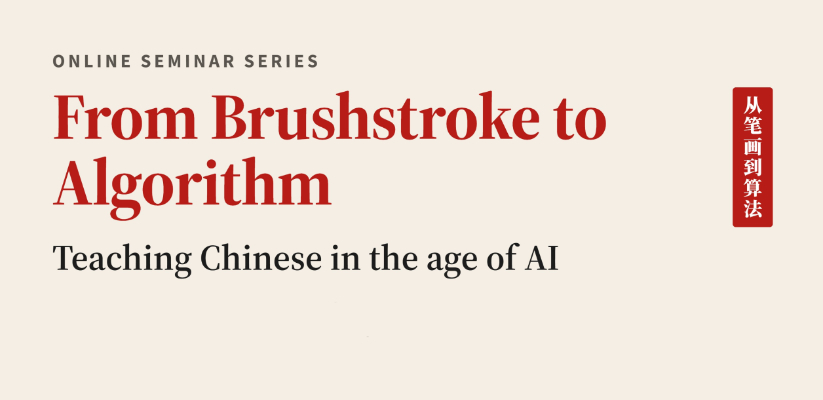
Del trazo al algoritmo: enseñar chino en la era de la IA
Publicado Miércoles 11 de Noviembre, 2026
La inteligencia artificial ya forma parte del aula de chino. Pero ¿la usamos con suficiente espíritu crítico? ¿Le sacamos todo el partido posible? Este ciclo de seminarios en línea sobre literacidad en IA en la didáctica del chino como lengua extranjera reúne a profesorado e investigadores para responder a estas y muchas otras preguntas.
En tres sesiones, expertos internacionales compartirán la investigación más reciente sobre las competencias en IA que necesita hoy el docente de chino: cómo integrar la IA generativa con sentido pedagógico, cómo revisar sus resultados y qué tareas no deberían delegarse nunca. El ciclo quiere ser un espacio para reflexionar, aprender y compartir experiencias e inquietudes con otros colegas, y para hacer de la tecnología una aliada sin perder la mirada crítica.
Información práctica
- Fechas: viernes 15, 22 y 29 de enero de 2027
- Horario: de 10:00 a 11:30 h (hora de Barcelona, CET)
- Formato: en línea. Cada sesión incluye una conferencia de 60 minutos y 30 minutos de preguntas.
- Idioma: inglés
- Inscripción: la asistencia es gratis mediante registro a través del siguiente formulario . El enlace de cada ponencia se enviará por correo electrónico a las personas inscritas previamente a cada sesión.
Programa
15 de enero de 2027. Dr Weiming Liu (Dublin City University): Teachers, learners and GenAI: Rethinking the teaching and learning of Chinese as a foreign language
22 de enero de 2027. Dr Yu-Ju Lan (National Taiwan Normal University): From AI Tools to Pedagogical AI Agents: Rethinking the Teaching and Learning of Chinese as a Foreign Language
29 de enero de 2027. Dr Chin-Hsi Lin (The University of Hong Kong): From Teacher Learning to the Chinese Language Classroom: Bringing Generative AI into Teaching Practice
Resúmenes y ponentes
Los resúmenes de las conferencias y la presentación de los ponentes se reproducen en inglés, la lengua del ciclo.
Session 1 · Friday 15 January 2027 · 10:00–11:30 CET
Teachers, learners and GenAI: Rethinking the teaching and learning of Chinese as a foreign language
Dr Weiming Liu, Dublin City University, Ireland
The growing accessibility of generative artificial intelligence (GenAI) is creating new possibilities for teaching and learning Chinese as a foreign language (CFL). However, the availability of increasingly capable GenAI tools does not necessarily translate into meaningful pedagogical innovation. Understanding their educational value requires attention not only to what these technologies can offer, but also to how learners engage with them, how teachers evaluate their suitability and the conditions under which they are used. Drawing on three complementary strands of research, this seminar examines GenAI in CFL education from learner, teacher and research perspectives. First, a recently published study of university students learning Chinese in Ireland identifies three preliminary learner orientations towards GenAI, including pragmatic use, critical engagement and principled non-use. These findings suggest that learners’ relationships with GenAI extend beyond straightforward acceptance or rejection. Second, an exploratory study of CFL teachers examines their reported uses of GenAI and their evaluations of its pedagogical suitability. The findings highlight tensions between the efficiency of generating instructional resources and the professional judgement required to assess their linguistic reliability, appropriateness for learners and relevance to educational purposes. Third, a review of empirical studies on ChatGPT-supported CFL learning identifies four thematic areas: linguistic scaffolding, learner engagement, relational and affective dimensions and contextual constraints. Bringing these strands together, the seminar highlights the importance of aligning GenAI use with pedagogical purposes and learners’ educational needs. It concludes by discussing the implications for CFL pedagogy, language teacher education and future research, with a particular focus on developing critical, context-sensitive and pedagogically informed approaches to GenAI integration.
About the speaker. Dr Weiming Liu is an Assistant Professor of Chinese and Applied Linguistics and PhD Studies Convenor in the School of Applied Language and Intercultural Studies at Dublin City University, Ireland. His research interests include technology-enhanced language teaching and learning and language teacher education.
Session 2 · Friday 22 January 2027 · 10:00–11:30 CET
From AI Tools to Pedagogical AI Agents: Rethinking the Teaching and Learning of Chinese as a Foreign Language
Dr Yu-Ju Lan, National Taiwan Normal University, Taiwan
Generative artificial intelligence (AI) is transforming foreign language education by offering new opportunities, but it is also raising concerns about learners’ overreliance on AI-generated content. This presentation will explore the shift from generative AI tools to pedagogical AI agents that serve as meaningful learning partners rather than merely providing answers. Drawing on research and practical applications, the presentation discusses how teachers can design these agents based on learning theories, instructional goals, and learner needs. Through structured interactions, guided questioning, and personalized feedback, these agents can support language development, critical thinking, and self-regulated learning. The presentation will also introduce the HUMAN framework, which emphasizes humanity, understanding, metacognition, agency, and nurture as guiding principles for responsible AI integration. By combining pedagogically designed AI agents with human-centered principles, the presentation will demonstrate how AI can enrich the teaching and learning of Chinese as a foreign language while preserving teacher autonomy and fostering meaningful human interaction.
About the speaker. Yu-Ju Lan is a Distinguished Professor at National Taiwan Normal University. She specializes in integrating AI, the metaverse, and emerging technologies into language learning and teacher education, with a particular focus on learner engagement, instructional design, and learning effectiveness. Professor Lan has been named to the Stanford/Elsevier Top 2% Scientists list in the annual ranking since 2020 and in the career ranking since 2022, reflecting her sustained scholarly impact. Her research has been supported by multiple externally funded projects and recognized with the 2022 Outstanding Research Award from Taiwan’s National Science and Technology Council. Her academic achievements, together with her contributions to building academic community, through founding the PPTELL Association, now the Taiwan CALL Association, and the AI3L community, earned her the Distinguished Researcher Award from the Asia-Pacific Society for Computers in Education in 2026. Professor Lan serves as Co-Editor-in-Chief of two SSCI, Q1 journals, Educational Technology & Society and Language Learning & Technology , contributing actively to international research collaboration and providing academic leadership in educational technology and language education.
Session 3 · Friday 29 January 2027 · 10:00–11:30 CET
From Teacher Learning to the Chinese Language Classroom: Bringing Generative AI into Teaching Practice
Dr Chin-Hsi Lin, The University of Hong Kong
This seminar examines how teachers learn to integrate generative AI into Chinese language teaching, from exchanges in professional communities to decisions about classroom activities. Drawing on research into a Facebook teacher learning community, teachers’ informal learning networks, and their processes of integrating generative AI, I explore how teachers encounter new ideas, try them out, and adapt them to their teaching. Examples from AI-supported multimodal composition and an ongoing study of preservice teachers’ imagined and perceived AI classrooms connect these questions to language learning. The seminar focuses on the judgments that link teacher learning with student learning: what AI can contribute, what teachers need to decide, and how students can retain opportunities to interpret, create, and revise.
About the speaker. Dr Chin-Hsi Lin is an Associate Professor in the Faculty of Education at the University of Hong Kong. His research focuses on AI-supported language learning, digital literacy, and teachers’ professional learning, with particular attention to Chinese language education.
Organización
Grupos de investigación TXICC y GELEA2LT
Departamento de Traducción, Interpretación y Estudios de Asia Oriental (UAB)
Con la financiación de
Universitat Autònoma de Barcelona y Fundació Institut Confuci de Barcelona.

